Introduction: Why Use an ERP RFP Template?
Finance keeps its numbers in one system. Operations tracks inventory in spreadsheets. Reporting means someone exports three files and stitches them together at month-end. That is the situation that sends most companies shopping for an ERP.
An ERP RFP template is a structured document that explains your needs and lets you compare vendor proposals against the same criteria. Without one, every vendor answers a different question.
Cost and schedule risk are real. In the Panorama 2026 report, more than a quarter of respondents ran over budget.
This guide covers preparing requirements, completing each template section, evaluating real business fit, and avoiding an RFP that is long but useless.
Key Takeaways
- Tie every requirement to a business problem and a measurable outcome.
- Make vendors label each answer: standard, configured, customized, third-party, or unavailable.
- Compare implementation, integrations, support, and total cost, not feature counts.
- A focused requirements list plus scripted demos beats a bloated RFP.
What Is an ERP RFP Template, and Do You Need One?
What an ERP RFP template does
An ERP request for proposal invites shortlisted vendors or implementation partners to propose a solution, delivery approach, timeline, and pricing based on your defined requirements. The template gives everyone a common structure:
- Company background and project scope
- Functional and technical requirements
- Implementation expectations
- Pricing and vendor qualifications
- Evaluation rules
RFP vs. RFI vs. RFQ
GSA's guidance separates the three documents:
| Document | Purpose |
|---|---|
| RFI (information) | Early information gathering, not a bid |
| RFP (proposal) | Detailed proposals for a complete solution, judged on multiple factors |
| RFQ (quotation) | Pricing for clearly defined requirements |
An RFI helps when you are still learning the market. Skip the RFP until you know your own priorities, or vendors will fill the gaps with their own assumptions. A three-document sequence is not mandatory.
When a formal ERP RFP makes sense
A formal RFP fits when you have:
- Complex integrations or multiple entities and departments
- Significant implementation risk
- Procurement rules or a documented approval process
Smaller, simpler projects can often use a prioritized requirements list, identical demos, cost comparisons, and reference checks. The tradeoff, as TechTarget's ERP comparison notes, is a higher risk of missed requirements.
Prepare Your ERP Requirements Before Filling In the Template
Define business outcomes and current-state problems
Write down what is actually broken: manual accounting work, inconsistent inventory counts, slow approvals, duplicate data entry, weak reporting. Then attach an outcome and a test to each requirement. "Close the month in five days" is checkable. "Better reporting" is not.

SP Merchant Bank faced a familiar starting point: its operational system was outdated, missed required functions, and was no longer supported by its vendor. A trucking and warehouse client outgrew the spreadsheets it used for inventory and orders.
Gather input from every affected stakeholder
Run interviews or workshops with finance, accounting, operations, sales, procurement, warehouse, HR, leadership, and anyone in IT who depends on the system.
As you collect that input:
- Name a decision-maker for conflicts
- Assign an owner to each requirement
- Separate personal preferences from company-wide needs
Inventory current systems, data, and integrations
List accounting software, spreadsheets, payroll, CRM, inventory tools, reporting platforms, paper processes, and any outside application that must exchange data.
Data deserves extra attention. According to Panorama's 2025 ERP Report, data quality problems were the most common reason projects ran over schedule.
Document who owns the data, its condition, migration needs, and security requirements. Treat "integration available" as a claim to verify, not a working connection.
Prioritize and phase the requirements
Sort requirements into must-have, should-have, and future. Flag what must work on day one. A vendor with the longest feature list can still stumble on your core financial or operational workflow.
Set the process rules before you issue the RFP
Define each of the following before vendors see the RFP:
- Response format and single communication channel
- Q&A process and submission deadline
- Confidentiality terms
- Demo process and decision timeline
If you lack internal technology leadership, Your Virtual CIO, LLC offers a free 2-3 hour technology assessment that clarifies current systems, process gaps, and ERP priorities before you send anything out.
ERP RFP Template: Sections and Fields to Include
Company background and project rationale
Include:
- Industry, business model, legal entities, and user groups
- Growth plans and current systems
- Why you are changing, plus strategic goals and pain points
- Regulatory or industry considerations vendors must understand
Project scope and implementation expectations
Cover:
- Modules and departments in scope
- Expected users and deployment preference
- Milestones and who does what (vendor versus internal)
- Data migration assumptions
Require each vendor to describe:
- Methodology and governance
- Training and change management
- Testing, cutover, and go-live support
- Post-launch stabilization
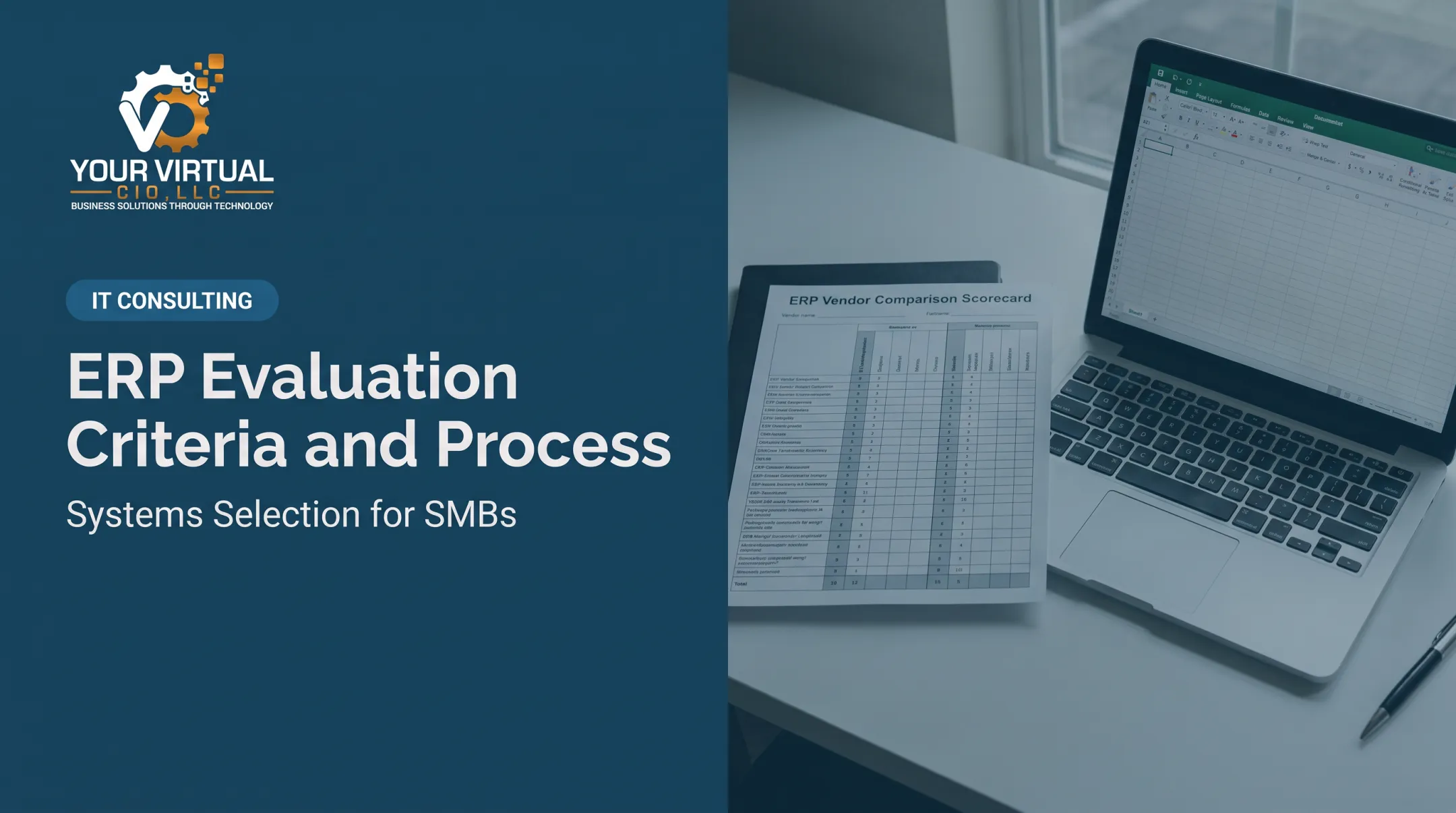
Functional requirements and response matrix
Copy this column layout:
| Field | Purpose |
|---|---|
| Requirement ID | Reference number |
| Business process | Where it applies |
| Description | What is needed |
| Priority | Must / should / future |
| Vendor response | Standard, configured, customized, third-party, unavailable |
| Dependencies and assumptions | What the answer relies on |
| Evidence and comments | Demo, documentation, notes |
Representative areas: finance and accounting, procurement, sales, inventory, order management, project operations, manufacturing or service workflows, reporting, and user access. Delete modules you do not need.
Technical, security, data, and integration requirements
Ask vendors to address:
- Cloud, on-premises, or hybrid deployment, and architecture
- APIs, integration tools, and identity management
- Role-based access, encryption, backups, and disaster recovery
- Upgrades, availability, and data retention
- Applicable US compliance obligations (SOC 2, PCI DSS, SOX where relevant)
Compliance applicability varies. SOC 2 reports cover a vendor's service controls. PCI DSS applies if payment data is involved. GAO's SOX analysis shows Section 404 auditor attestation is aimed at public companies, so it is not a blanket requirement for smaller firms.

For each integration, ask whether it is native or partner-built, who maintains it, and what happens when either platform changes.
Pricing, vendor qualifications, submission, and evaluation
Request itemized one-time and recurring costs, with all pricing assumptions:
- Licenses or subscriptions
- Implementation, configuration, and customization
- Integrations and data migration
- Training, support, and upgrades
- Your internal staff time
Also ask for:
- Similar implementation experience and named project staff
- Customer references and the support model
- Service-level commitments and product roadmap
- Contract terms, response instructions, evaluation criteria, and the clarification process
How to Evaluate ERP RFP Responses and Avoid Selection Mistakes
Normalize how vendors answer
Every response should be labeled standard, configuration, customization, third-party, or unavailable. Capture cost, effort, dependencies, and maintenance implications for each. Customizations raise upgrade and maintenance burdens. Third-party add-ons should be named and priced.
Do not accept an unqualified "yes." Ask for a demo, documentation, or other evidence.
Score critical fit, not feature counts
Set the scoring method and weights before proposals arrive. Weight these areas more heavily:
- Financial control
- Customer service
- Operational continuity
- Reporting and compliance
- Growth readiness
One public example: Catawba County's 2026 ERP RFP weights functionality and integrations at 30%, technical and support 20%, implementation approach 20%, cost 15%, and vendor experience 15%. Those are one buyer's weights, not a standard.

Treat non-negotiables as gates. A high total score should never hide a serious gap in a critical workflow.
Validate through scripted demonstrations
Give every finalist the same realistic scenarios:
- Quote-to-cash
- Procure-to-pay
- Inventory movement
- Month-end reporting
- Project billing and approval workflows
In each scenario, require them to show:
- What is out of the box versus configured or customized
- How users complete each step
- What data moves between systems Pacific Grove's 2026 ERP RFP uses multi-day scripted demonstrations for this reason.
Testing matters in practice. When Your Virtual CIO evaluated packages for SP Merchant Bank, it tested each one to confirm it did what the vendor claimed.
Evaluate the implementation team and support
The people who deliver matter more than the logo. Check their experience with:
- Similar organizations
- Accounting and operational processes
- Migration, training, and integrations
Also review support channels, escalation paths, response commitments, upgrade responsibilities, documentation, and knowledge transfer. Can your team handle routine administration after go-live?
Compare total cost and implementation risk
Normalize proposals to the same scope and time horizon. Include:
- Recurring fees and services
- Extra modules and users
- Integrations and custom work
- Migration, training, and support
- Upgrades and internal effort
Watch for assumptions that inflate cost later:
- Unpriced data cleansing
- Excluded integrations
- Required third-party applications
- Limited reporting
- A shifting implementation timeline
Challenge the proposal with questions and references
Run a controlled Q&A, share material clarifications with all vendors, and document any changed commitments. Call customer references about:
- Implementation problems and budget changes
- Support quality and adoption
- Life after go-live
If you use AI to draft requirements or compare proposals, verify it. NIST's generative AI profile warns of factual errors and fabricated citations, so have a knowledgeable person review the output.
Conclusion: Build a Focused, Business-Led ERP RFP
The strongest ERP RFP templates stay concise. They give vendors enough business, process, technical, and commercial context to send comparable proposals.
Follow this sequence:
- Document current-state problems.
- Prioritize requirements.
- Complete the template.
- Set evaluation rules.
- Validate finalists with demonstrations.
- Confirm implementation and cost assumptions before signing.
Frequently Asked Questions
What are the four types of ERP?
There is no single universal four-type classification. ERP is commonly grouped by deployment (on-premises, cloud, hybrid), business size or complexity, and generic versus industry-specific scope.
What is ERP in PMO?
An ERP can support a PMO through project budgets, resource scheduling, time and expense tracking, project accounting, and reporting. Capabilities vary by product, so check them against your governance needs.
What does RFP stand for in supply chain?
Request for Proposal. Supply chain teams use it to ask vendors for detailed proposals covering solutions, services, implementation plans, and pricing.
What should be included in an ERP RFP template?
Company background, project scope, prioritized functional and technical requirements, implementation expectations, pricing, vendor qualifications, submission rules, and evaluation criteria.
How do you evaluate ERP RFP responses?
Use prioritized scoring, require a delivery-method label per requirement, run scripted demos, and assess the implementation team. Compare total cost, check references and support, and validate technical claims.
Do small businesses need an ERP RFP?
Often not a formal one. A focused requirements document and a consistent vendor evaluation process still reduce selection risk.